Barges on the River Liffey move through the center of Dublin, Ireland’s capital city. The River Liffey flows approximately 125 kilometers (78 miles) from the Wicklow Mountains to Dublin Bay, dividing Dublin into the Northside and Southside. Historically, the river has played a key role in Dublin’s trade and transport, with cargo vessels and barges navigating its tidal waters. Today, boats remain visible along the waterfront, passing under well-known bridges such as the Ha’penny Bridge and Samuel Beckett Bridge. The River Liffey continues to be a central geographic, economic, and cultural feature of Dublin, Ireland.
GPO 1916 refers to the General Post Office in Dublin, which played a central role during the 1916 Ea...
Step back to 1975 and witness the iconic Guinness boats docked at Custom House Quay, ready to transp...
Step back in time with this historic 1967 photograph of O’Connell Street, one of Dublin’s most iconi...
Step back in time to Moore Street in the 1930s, one of Dublin’s most iconic markets. This historic s...
The 1967 image of O’Connell Street captures a lively scene in the heart of Dublin during a time of c...
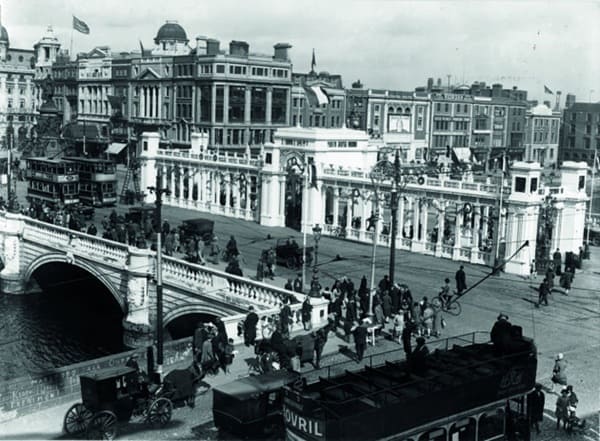
O’Connell Street Bridge, spanning the River Liffey in the heart of Dublin, was completed in 1794 and...
The General Post Office (GPO) on O’Connell Street in Dublin has long been one of the city’s most ico...
North Frederick Street in Dublin is more than just a city street—it is a living record of the city’s...